
A live nine-part series for parents and caregivers of children from birth to seven. Explore practical, developmentally grounded ways to nurture rhythm, warmth, play, rest, and connection at home.
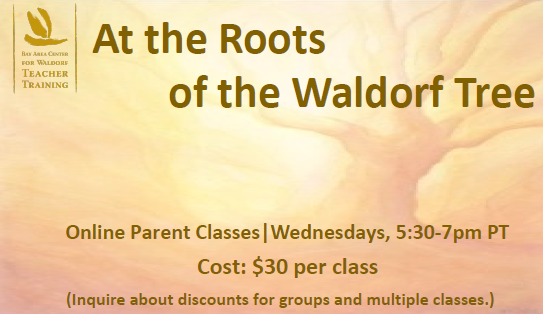
October – December 2026
Focus on Early Childhood—Birth to Seven Years Old
Wednesday, October 7, 2026
“Pregnancy, Birth, the First Few Months, and the First Year: Creating a Strong Foundation for Family and Home” with Kate Hammond
Pregnancy and early postpartum can be a special time. In this workshop, we will look at the times of expectation, birth, and the transition into parenting from a spiritual perspective. What is unique about this stage of our lives? How can we best prepare ourselves?
Kate Hammond is a Waldorf graduate and has taught early childhood and grades for over 30 years. She is a parent coach, an adult educator, and a Spacial Dynamics® trainer. Kate is the author of Why Be Screen Free?
Wednesday, October 14, 2026
“Creating a Warm and Peaceful Home Environment for Your Child to Flourish” with Kate Hammond
The environment of the family and home can be a powerful tool for bringing stability and joy to your family life with young children. In this talk and discussion, we will look at indoor and outdoor environments that foster engagement, predictability and practicality. We will also consider the element of warmth and the importance of this aspect for your young child.
Kate Hammond is a Waldorf graduate and has taught early childhood and grades for over 30 years. She is a parent coach, an adult educator, and a Spacial Dynamics® trainer. Kate is the author of Why Be Screen Free?
Wednesday, October 21, 2026
“Your Cloak of Equilibrium and Self-Care for Parents: What to Do When the Oatmeal Has Burned” with Anna Rainville
Parenting is a required course in ingenious self-development. What do you need to learn in order to find and maintain a healthy sense of presence in the midst of daily challenges? This evening session will explore practical ways to tend the details of household rhythms while nurturing your own soul.
Anna Rainville is a Waldorf early childhood and class teacher with over 40 years experience. She mentors and teaches Waldorf teachers worldwide. Anna is the author of Singing Games for Families, Schools, and Communities.
Wednesday, October 28, 2026
“Sleep: Why Children Need So Much and How We Can Support Transitions with Bedtime Routines, Rituals, Stories, and Songs” with Diane David
When we as parents look at our small, sleeping child, it fills our hearts with love. The deep satisfaction of watching one’s child sleep, safe and sound in their little bed, is perhaps universal. It is wonderful to get a good night’s sleep and to get the sleep you need. In our sleep, we charge up for the next day’s experiences, processing the day that has just passed and detoxing our brains. Being human, we are dependent on our sleep—and one could also say that having a good day is dependent upon having a good night’s sleep.
Diane David is the Early Childhood Director of the Bay Area Center for Waldorf Teacher Training. She has taught Waldorf early childhood for over 40 years and is a member of the teacher education committee of WECAN.
Wednesday, November 4, 2026
“Interesting Questions: Ways to Respond to Your Young Child’s Questions” with Steve Spitalny
The young child is filled with curiosity about the world and this often comes out as questions to adults. Parents may feel obliged to provide complex, factual answers of intellectual information that is not what the child needs. How can we understand the developmental needs of the young child and support them in our verbal communications? How can we satisfy their curiosity with imaginative answers that are true?
Steve Spitalny taught at the Santa Cruz Waldorf School for almost 40 years. He has taught at Rudolf Steiner College and Waldorf Institute of Southern California (WISC), and was a board member of the Waldorf Early Child Association of North America (WECAN). He authored three books about the world of the young child: Connecting With Young Children: Educating the Will, Conscious Parenting: A Guide to Living with Young Children, and What’s the Story: Storytelling as a Path Toward Living Happily Ever After. He has also written numerous articles for various journals, magazines, and book collections, and his work has been translated into several languages.
Wednesday, November 11, 2026
“The World of the Young Child Before Writing” with Kenneth Smith
For millions of years, humanity lived and developed without writing, instead depending on word of mouth, oral traditions, and memory. With the beginning of writing, new capacities are not only formed but other capacities diminish. Today there is a lot of pressure for children to move quickly out of their pre-writing era and into script-based literacy and numeracy, but what are they at risk of losing and why should we proceed slowly during the early years?
Ken Smith is the Director of the Bay Area Center for Waldorf Teacher Training and the Healing Through Art Program. For over 30 years, he has been teaching in Waldorf schools and adult education centers around the world.
Wednesday, November 18, 2026
“Living Into the Festivals of Light with Young Children” with Diane David
Why is it important that the young child experiences the changes of the seasons? How we can bring light, joy, and reverence into this darkest time of the year? Let us explore the Festivals of Light – Advent, Christmas, Hanukkah, Solstice and Kwanza – and how we can bring meaning to them for the young child, counteracting the stresses and consumerism of the season.
Diane David is the Early Childhood Director of the Bay Area Center for Waldorf Teacher Training. She has taught Waldorf early childhood for over 40 years and is a member of the teacher education committee of WECAN.
Wednesday, December 2, 2026
“Free and Undirected Play: A Time to Move Beyond Boredom and Into the World of Creativity and Imagination” with Diane David
Children today have too much of their lives scheduled and planned out for them. Time for free play is essential for the development of the brain and imagination, allowing deep ideas and interests to rise to the surface. Free play in childhood is filled with the forces that enhance creativity, inventiveness, and problem-solving capacities later in life.
Diane David is the Early Childhood Director of the Bay Area Center for Waldorf Teacher Training. She has taught Waldorf early childhood for over 40 years and is a member of the teacher education committee of WECAN.
Wednesday, December 9, 2026
“The Seasonal Nature Table: Bringing the Sacred Life of Nature Into Your Home and Your Children’s Lives” with Kate Hammond
Creating a nature table is a tradition in Waldorf kindergartens and early grades. It is a special artistic arrangement of natural materials where the life and rhythms of nature are observed and the seasons and festivals are gently celebrated. You may bring this activity into your home and engage with your children in connecting with the course of nature.
Kate Hammond is a Waldorf graduate and has taught early childhood and grades for over 30 years. She is a parent coach, an adult educator, and a Spacial Dynamics® trainer. Kate is the author of Why Be Screen Free?
For more information, please contact: tiffany@bacwtt.org | (415) 479-4400 | www.bacwtt.org